
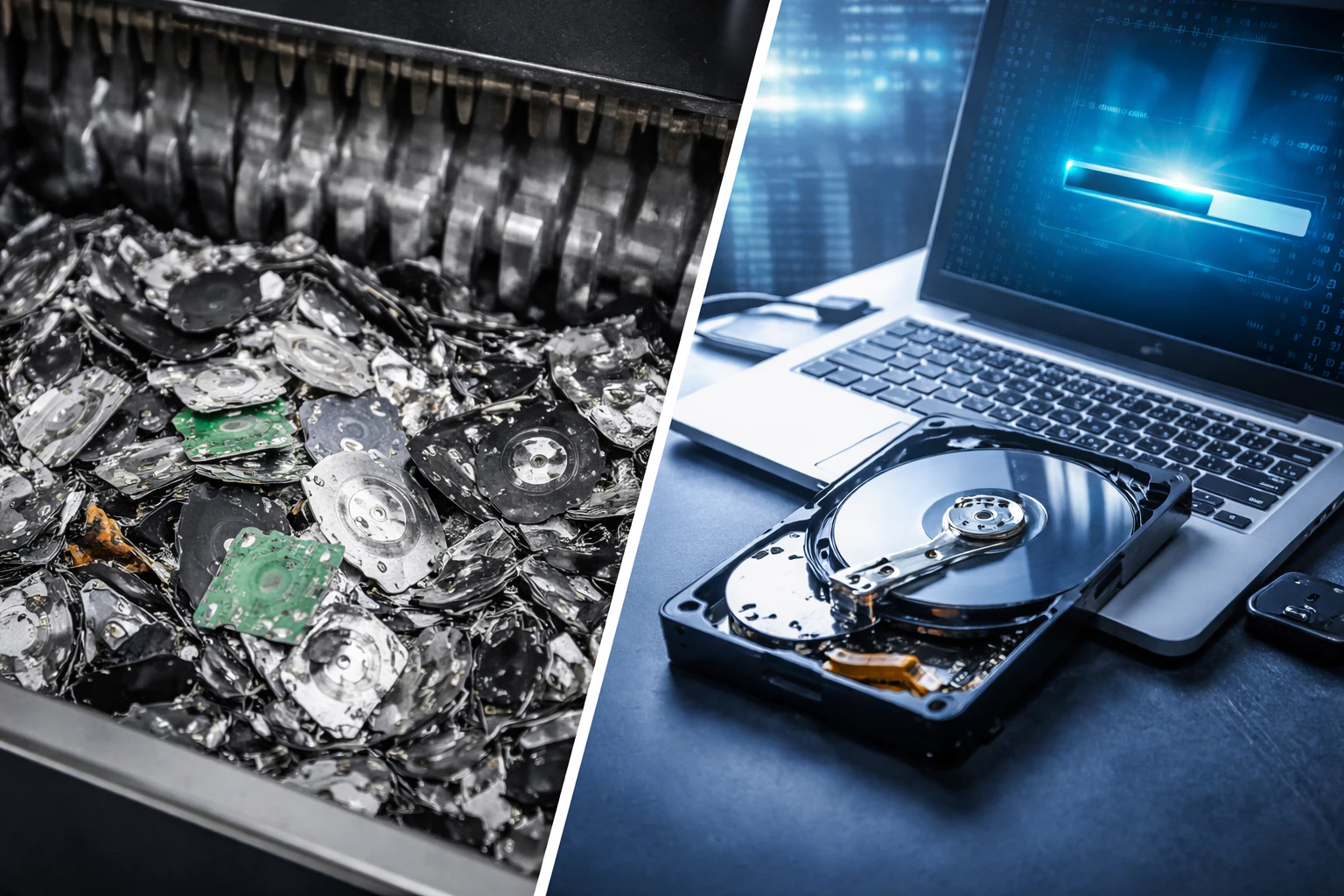
Hard Drive Shredding vs. Data Wiping: Which Data Destruction Method Is More Secure?
Retiring old hard drives? Simply deleting files leaves your sensitive business data vulnerable to recovery. Discover the critical differences between software-based data wiping and physical hard drive shredding, and learn which option provides the ultimate security and compliance for your end-of-life hardware.
Data security does not end when a hard drive reaches the end of its life cycle. Old drives still contain sensitive files, credentials, and business information that criminals can exploit if devices are discarded improperly.
Two common data destruction methods are used to dispose of old drives: Hard drive shredding physically destroys the device, while data wiping uses software to overwrite stored information. While both approaches aim to protect data, they do not provide the same level of security.
Find out in this article why data destruction matters, how each method works, and which option stands up to real-world compliance and audit expectations.
Key takeaways
- Deleted or formatted drives can still contain recoverable data, and improper disposal can lead to breaches, legal exposure, and compliance issues.
- Hard drive shredding physically destroys storage media into small fragments, while data wiping uses software to overwrite data so it cannot be read or recovered.
- Shredding delivers the highest security certainty because the drive is permanently destroyed, while wiping can be secure but depends on drive health, the wipe method, and proper verification, especially for SSDs and failed drives.
What Happens When a Hard Drive Is Retired
Retired traditional hard disk drives (HDDs), solid state drives (SSDs), and hybrid storage devices still contain stored information even when they are no longer in use. Simply deleting files or formatting a drive only removes the file pointers, leaving the actual data on the hardware until it is overwritten or permanently destroyed. If discarded improperly, these drives can be accessed using forensic tools that extract residual information, creating serious security risks such as identity theft, financial fraud, and unauthorized corporate access.
Regulations such as HIPAA, PCI Data Security Standard (PCI DSS), and various state privacy laws require organizations to dispose of electronic storage devices securely to prevent unauthorized access. Destroying hard drives before disposal ensures that confidential information never leaves the organization’s control and protects businesses from legal liability and reputational damage associated with data breaches.
How Does Hard Drive Shredding Work?
Hard drive shredding is a physical destruction process that breaks storage devices into tiny fragments using industrial-grade shredding equipment. The process removes the possibility of data recovery by destroying the internal components that store information.
During shredding, the drive is fed into a powerful shredder that tears the metal casing, magnetic platters, and electronic circuitry into small pieces. Because data is stored magnetically on the platter surfaces, destroying the platters eliminates the possibility of reconstructing files.
How Data Wiping Works to Overwrite and Erase Stored Information
Data wiping is a software-based method that overwrites stored information with new data patterns. The goal is to replace existing files with random characters, zeros, or structured overwrite sequences so the original information cannot be read.
However, wiping does not guarantee absolute data elimination. Bad sectors, firmware storage areas, and advanced recovery technologies can sometimes expose residual data fragments.
Hard Drive Destruction vs. Data Wiping: Which Offers Better Data Security?
Security Level
Shredding produces physical fragments that are impossible to read or reconstruct, eliminating risk from residual magnetic signals or firmware vulnerabilities. Data wiping, on the other hand, relies on software signals and overwriting commands. If a drive has bad sectors, hidden partitions, or firmware corruption, wiping can leave traces of data behind.
Effectiveness on SSDs
SSD technology spreads data across memory cells and uses wear leveling to extend drive life. Standard overwrite techniques do not guarantee that every cell is rewritten. Some manufacturers provide built-in secure erase commands, but these are not universally implemented.
Because hard drive destruction physically destroys the flash memory chips, it is dependable for all types of drives.
Verification and Proof
Hard drive shredding services provide a certificate of destruction. This paper or electronic record documents the chain of custody and destruction details. In audits and compliance reviews, these certificates are strong proof that drives were destroyed properly.
With data wiping, verification requires forensic validation by third-party tools, and even then, forensic tools can disagree on whether data is truly unrecoverable.
Time and Cost Considerations
Data wiping can be slower and requires access to functioning drives. In large-scale retirements or mixed device environments, shredding is faster and does not require that the drive be functional. On-site shredding eliminates the need to transport potentially sensitive devices off your property.
How Viking Shred’s On-Site Millimeter-Level Shredding Delivers Ultimate Data Security
As the largest privately held mobile shredding company in Northern California, Viking Shred provides secure on-site hard drive destruction services designed for organizations that demand strong data protection. We can shred virtually any item down to millimeter-sized fragments, ensuring that magnetic platters and electronic storage components are destroyed beyond forensic reconstruction.
Our process supports compliance documentation by providing certificates of destruction immediately after shredding is completed. By maintaining physical control of devices until destruction is finished, we remove potential chain of custody risks and strengthen security accountability.
Safeguard Your Business with the Right Data Destruction Method
Choosing between hard drive shredding and data wiping ultimately comes down to security certainty. Data wiping can be useful in controlled environments where devices will be reused, but it does not eliminate all recovery risks. Physical shredding delivers the highest level of protection by destroying the storage media itself.
Viking Shred’s on-site millimeter-level hard drive destruction provides a reliable solution that protects organizations from data breaches, compliance violations, and unauthorized recovery attempts.
If your business needs secure shredding, reach out to us today to schedule on-site or off-site services and protect your sensitive information with confidence.