Data centers are under more pressure than ever to prove that sensitive data is truly destroyed, not just discarded. Traditional hard drive shredding methods that break drives into larger fragments are no longer enough to meet modern compliance standards or evolving security risks. Today, millimeter-level physical destruction of hard drives is becoming the new benchmark because it ensures data is rendered completely unrecoverable, even with advanced forensic tools. For organizations handling large volumes of sensitive information, this shift is not just a best practice but is also quickly becoming a requirement.
In this article, we explain what millimeter-level hard drive destruction means, why older disposal methods are no longer enough, and what data centers should look for in a secure destruction partner.
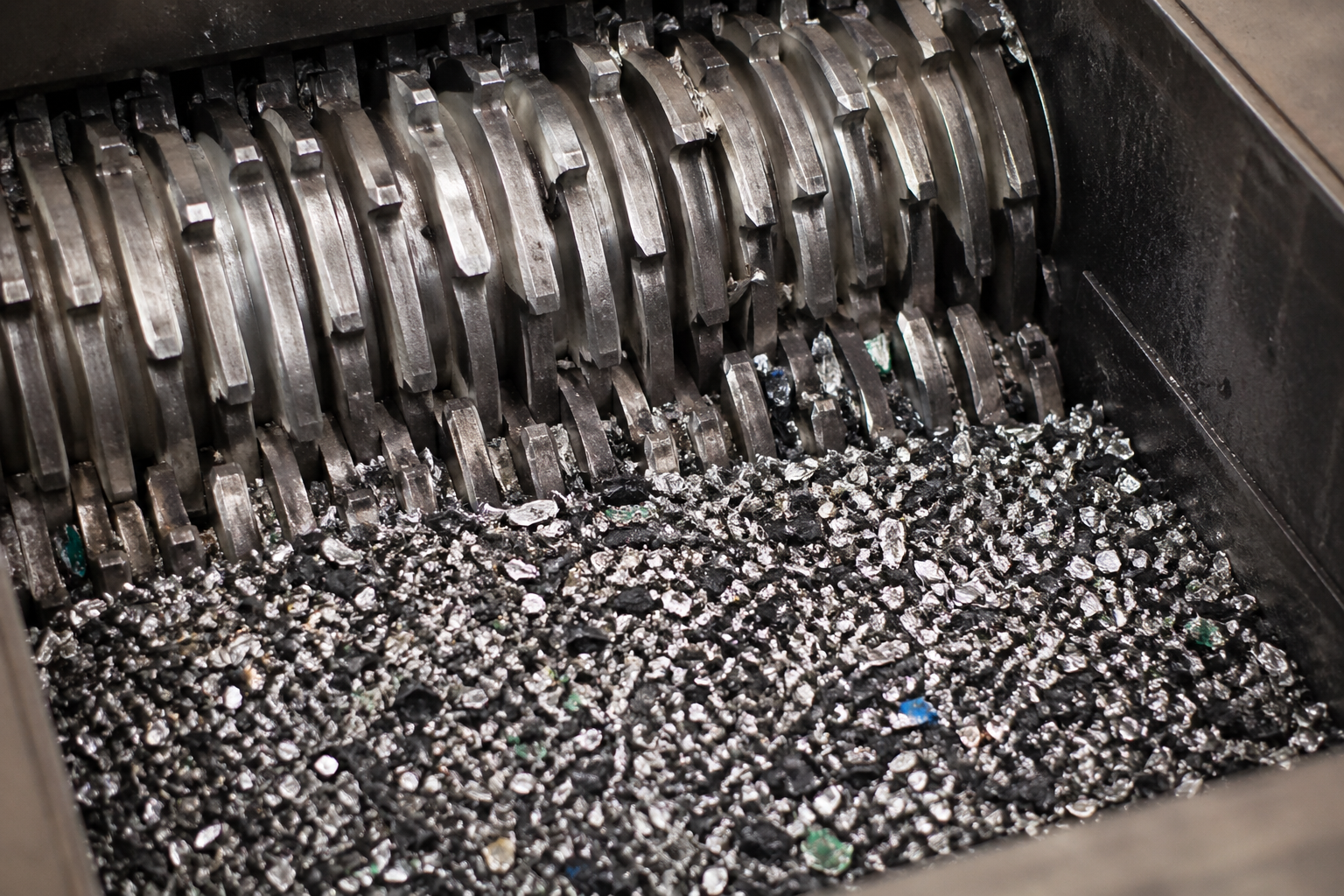
Millimeter-level shredding refers to the physical destruction of hard drives into extremely small particles, often as small as 2 mm or less. This level of precision goes far beyond older shredding methods that produced larger fragments, which could still pose a risk if reconstructed.
Why does size matter so much? Because data is stored magnetically across the platters inside a hard drive. When those platters are only partially damaged or broken into larger pieces, fragments of data can remain intact. With enough time and the right tools, bad actors could potentially recover that information.
By reducing drives to near dust-like particles, millimeter-level shredding eliminates that possibility.
Not all hard drive shredding produces the same result. Many standard shredding processes reduce drives to fragments roughly one to two inches in size. That may seem thorough, but forensic recovery tools can extract readable data from pieces that large, especially from solid state drives.
SSDs present a specific challenge. Unlike traditional hard disk drives, SSDs store data across flash memory chips distributed throughout the device. Degaussing, a magnetic erasure technique commonly used on HDDs, has no effect on SSDs at all. If shredding does not reduce those chips to a small enough particle size, data recovery remains technically possible.
Improper disposal can leave sensitive data exposed long after a drive has been removed from service. If that data is recovered, the organization may face compliance penalties, legal claims, reputational damage, and loss of customer trust.
The NIST Special Publication 800-88, "Guidelines for Media Sanitization," addresses this directly. It identifies physical destruction as the appropriate sanitization method for end-of-life media, with the level of destruction scaled to match the sensitivity of the data being protected.
Data centers retire storage media at a volume most businesses never approach. A single facility can retire thousands of drives each year, each potentially containing customer records, financial data, protected health information, or other sensitive data. If that media is not destroyed properly, the financial and compliance risks can be significant. IBM's 2024 Cost of a Data Breach Report found the average data breach costs $4.4 million, and for regulated industries, that figure climbs further once penalties are applied.
Data centers are not just storage facilities anymore. They are critical infrastructure that power industries, governments, and global services. With that responsibility comes tighter security expectations. That’s why modern hard drive destruction methods for corporate data centers must align with today’s security, compliance, and chain-of-custody needs.
Many regulatory frameworks now expect physical destruction methods that render data irretrievable. For this reason, hard drive shredding for data centers must produce smaller shred sizes that help organizations meet or exceed these expectations.
For example, the National Institute of Standards and Technology highlights physical destruction as a valid sanitization method when done properly. Smaller particle sizes provide stronger assurance that data cannot be reconstructed.
A single data breach can lead to legal consequences, financial penalties, and reputational damage. By adopting millimeter-level destruction, organizations reduce the chance that discarded drives could become a liability.
Modern hard drive shredding providers for data centers often combine small particle destruction with strict chain-of-custody protocols. This ensures drives are tracked from pickup to final destruction, adding another layer of accountability.
Large enterprises and hyperscale data centers are already moving toward more rigorous destruction standards. As these practices become more common, they set expectations across the industry.
Adopting this approach is not just about compliance. It also delivers practical benefits for organizations managing large-scale data.
Not all shredding services offer true millimeter-level destruction. If your organization is considering upgrading its process, here are a few things to evaluate:
As data storage continues to grow, hard drive destruction methods for corporate data centers must evolve to keep pace with modern security risks. Technologies like solid-state drives and hybrid storage introduce new challenges, but the principle remains the same. Data must be destroyed in a way that leaves zero chance of recovery. Millimeter-level hard drive destruction is not a passing trend; it is a direct response to evolving threats, stricter regulations, and higher expectations for accountability.
For data centers, data security does not end when a hard drive reaches the end of its life. In many ways, that is when the risk is highest. Viking Shred helps organizations close that gap with secure hard drive destruction designed to protect confidential information, support compliance, and provide peace of mind. Contact us today to schedule secure hard drive destruction and make sure your retired media is destroyed the right way.

